My brother is passionate about all things historic but his great passion is the Two World Wars. To have him as my own personal guide has indeed been a privilege. He knows the intimate details of the battles and the regiments that fought them. He expounds upon them with enthusiasm and makes it all come alive. I have found myself quite moved by many of the stories and it has been an incredible experience to actually walk in the trenches where those young men bravely fought for to save us from oppression.
“Theirs was not to reason why theirs was just to do and die!” (Alfred Tennyson – Charge of the Light Brigade)
Millions of young men sacrificed – I fail to take it in.
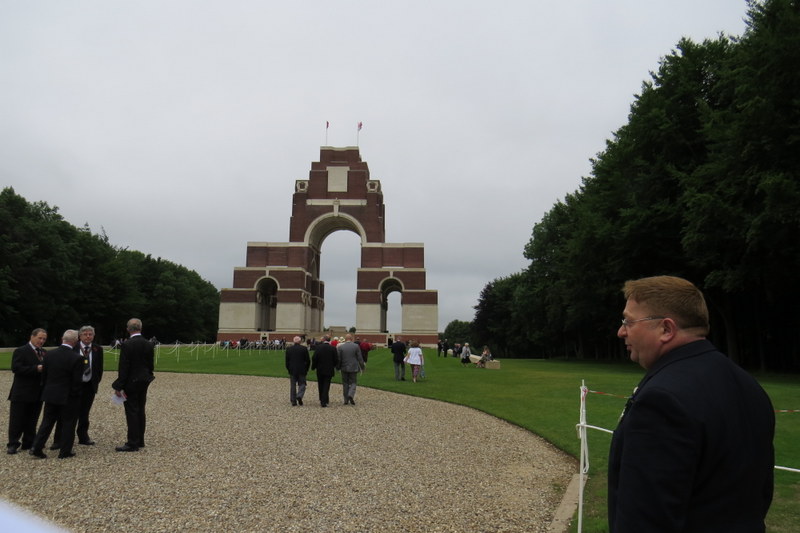
We went back to Thiepval Memorial today and I watched a video which nicely explained everything about the Battle of The Somme. We then went to have a close look at the Memorial and found the names of the soldiers, who fought and died with Reginald Lack (Nicholas has his portrait)
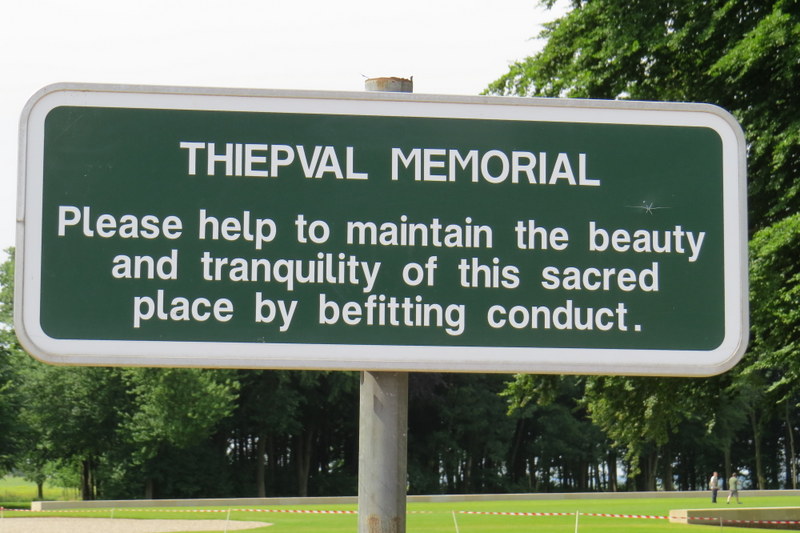
No Toy-toying allowed.

I found the name of a missing soldier named J.E. Fenwick.
We found the names of Wright and Radcliffe too and laid crosses down for them. (See previous Blog)


Me in front of Helen’s Tower
The Ulster Memorial Tower or Helen’s Tower was our next stop. Helen’s Tower in Clandeboye near Belfast was selected as the most appropriate building to replicate for the monument on the 1916 Somme battlefields. This was because most of the soldiers of the 36th Ulster Division did their initial training of the Clandeboye estate where the original Helen’s Tower stands. It commemorates the men of Ulster killed in The Great War especially the heavy losses suffered by 36th Division on 1st July 1916, the first day of the Battle of the Somme.
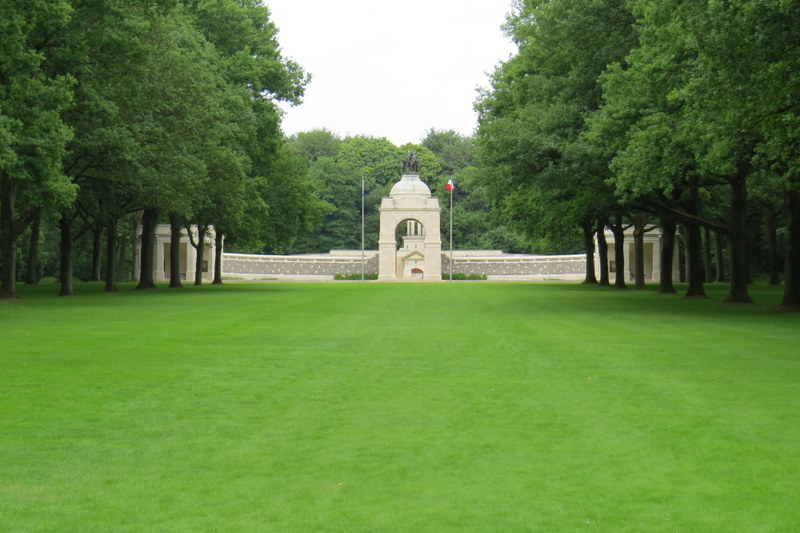
View toward the Delville Wood Memorial
The most moving part of my day was the visit to Delville Wood where many South African soldiers lost their lives. The memorial was built to commemorate them. It was designed by Sir Herbert Baker. Above the arch is Alfred Turner’s sculpture of the mythical figures of Castor and Pollux who represent the English and Afrikaans language groups being united. The main inscriptions are in both English and Afrikaans as well as French.

Above is a replica of the Castle of Good Hope in Cape Town. It was added as a museum in 1984. Inside there are relief carvings of all the wars fought by South Africans; The Great War, The Second World War and The Korean War. Amongst the exhibits are references to the liberation struggle in South Africa.
Something we were never taught at school was the Tragedy of the SS Mendi. She was a troop ship fully laden with South African Native Labour Corps soldiers. It was rammed in the English Channel at night during winter and sank. The Reverend Dyobha exhorted the dying men with these words, “Be quiet and calm my countrymen for what is taking place now is what you came here to do. We are all going to die and that is what we came for. Brothers, we are drilling the death drill. I a Zulu, say here and now that you are all my brothers, Xhosas, Swazis, Pondos, Basutu and all others, Let us die like warriors. We are the sons of Africa. Raise your war cries my brothers for they made us leave our assegais back in the kraals. Our voices are left with our bodies.”
Most of these brave men drowned. What a tragic end.
 The relief carving above depicts the desperation of the South Africans on the final day of The Battle of Delville Wood who tried to keep the Germans at bay. Three thousand South Africans entered the wood on the 15 July 1916 and on 20 July only 131 answered the roll call.

Die Laaste Boom/The Last Tree
All the trees but one were blown to bits except for this Hornbeam, much damaged but still growing. In the 1920s the wood was given to the South African Government as a permanent memorial and planted with oaks taken from Stellenbosch and Franschoek, towns settled by the French Huguenots in the 1600s who had brought oak seedlings with them from France.

Nicholas walking in one of the trenches
Walking through the new Delville Wood is so peaceful and it is beautifully kept. It is sobering to know that there are still bones of men blown to bits buried beneath the soil.
The South Africans had two mascots – Jacky the baboon and Nancy the Springbok

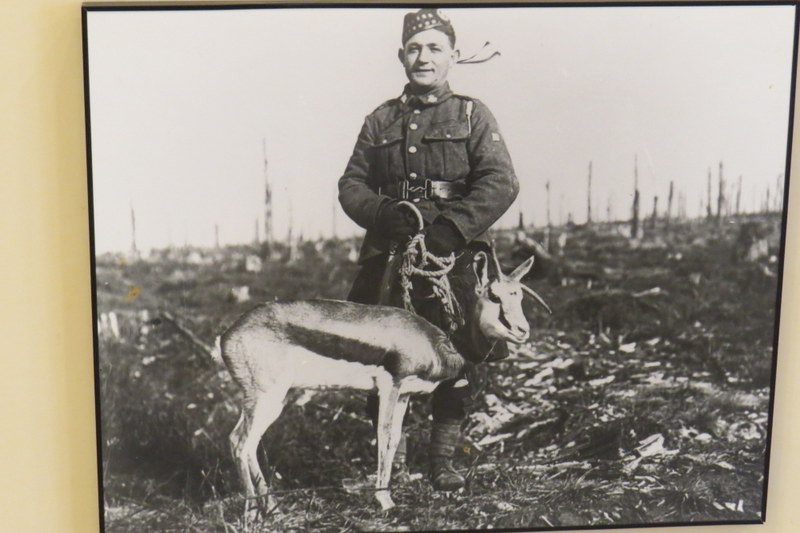
Nancy The Springbok
We went to look at the graves after a peaceful walk through the wood. I was touched by a wreath placed on a fallen soldier’s grave. He was remembered by his grandson, great-grandson and great-great grandson who had clearly only recently found out about him.

H Hodd will be remembered and never forgotten by his descendants
Our last visit of the day was to the Vis-En-Artois Memorial where our Great-Uncle Mark Kenney has his name inscribed on a memorial to the missing.

Vis-En-Artois Memorial
Nicholas and I placed crosses below his name.


Unfortunately his name is quite high up and faded on the right at the top
On a lighter note. I had commented to Nicholas that I thought we’d see rabbits or hares in France as I had once seen them coming into Charles de Gaulle Airport – Low and behold Nicholas spotted the most adorable hare hiding behind a gravestone.

A French Hare
Later we went to La Grande Place in Arras and had a delicious French meal at a very expensive restaurant and ate unpronounceable food. I know mine was Foie gras to start followed by Veal in a delicious mushroom sauce.

Our Restaurant
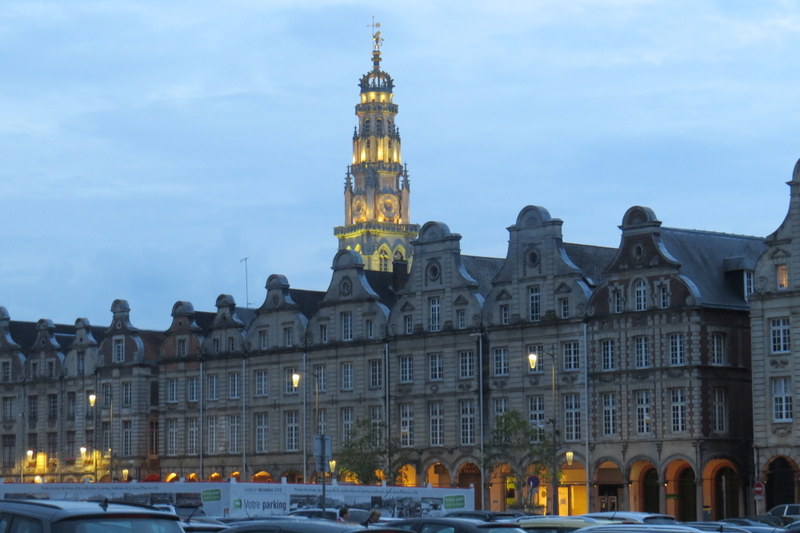
Hotel de Ville
The Town Hall tower was beautifully lit up.
I am not in France to see birds or wild life but the hare was special and the evening finished with this French Thrush posing nicely in the car park of our hotel.

A Thrush of some sort I think




 Diary of an Adventurous Retiree