1

Back in the classroom – Speaker Reader and Grade 1 Assembly

How often do I begin a blog with, “Oh wow, another exciting week at school is over!” or words to that effect.  Yes – there is always something happening at SVPS.  There is no time to get into a rut although we do make sure we get into good habits! On Wednesday, four of our Grade Ones competed in the finals of our Foundation Phase Speaker Reader Competition.

The week before that, they all said a poem or told a story to their teachers who chose the most promising to perform before the rest of the Grade Ones and from there we chose four to compete against the best in Grade 2 and 3.   You have to have a special kind of confidence to stand up on a stage in a big hall and say your piece before so many children, teachers and parents.  Your voice needed to be loud too as no microphones were used.   Our little Grade Ones made us so proud but I was the proudest of all when one of my girls came in Second Place when she recited the poem about a castle that needed painting!

My little star saying he piece
My little star saying he piece

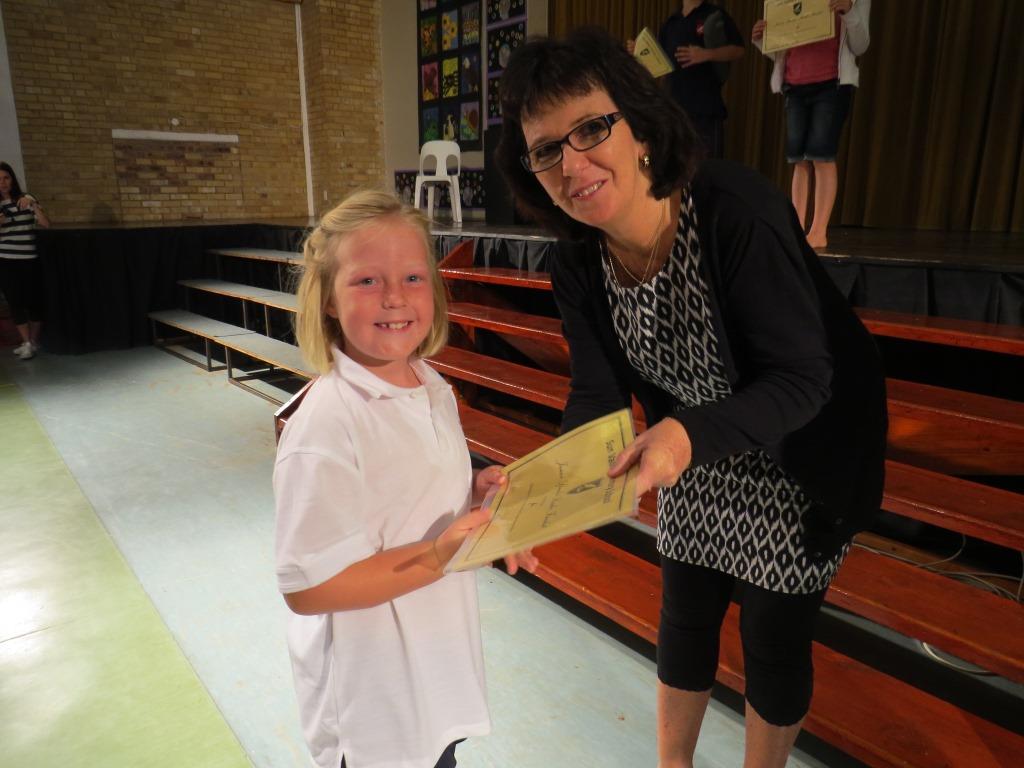
Receiving her Certificate

Receiving her Certificate

The Four Winners

The Four Winners

The standard was high and we were all wonderfully entertained by these talented young people.  But of course sitting still for so long gets us fidgety and so we had to have a break for a movement song.

The Robot Song

The Robot Song

Today the girls arrived at school in a high state of excitement.  They were all dressed in their clean white shirts ready to present their very first assembly!   Everything in Grade One is new and we have been learning routines and habits this was the theme of our presentation.  Congratulations girls, you made me proud. You recited your poem beautifully, moved wonderfully well to the Healthy Habits song and said your words loudly and clearly.  I know your moms and dads were thrilled to see you up on the stage this morning.

923480_602052539877464_188765081_n

Our First Assembly for 2014 – Routine and Habits

1911698_602052859877432_1754409248_n

Take Positive Risks

Our teacher are helping us this journey

Our teacher are helping us on this journey

Moving is important - The Healthy Habit Song

Moving is important – The Healthy Habit Song

Believe it or not Moms and Dads, in spite of all the practising for assembly we still managed to fit in a lot of work this week.  Our reading is improving by leaps and bounds, we are getting to grips with doubling and halving and having fun learning big numbers with dot to dot and other counting activities.

We are also playing hard on the sports field and some of us went to an athletics meeting in Kommetjie this week.   We have some very talented runners in our class!

1476417_602056603210391_1259426843_n 1898165_602056456543739_241641163_n 1939776_602057373210314_2106911638_n

Remember our Foundation Phase Athletics Day on Tuesday.  The fun race requires mom or dad’s shoes!   We are having a hilarious head day – so I am looking forward to seeing some funky hairstyles and hats.



1

Back in the Classroom – Speaker Reader Final, Group Teaching and Patterns in Nature

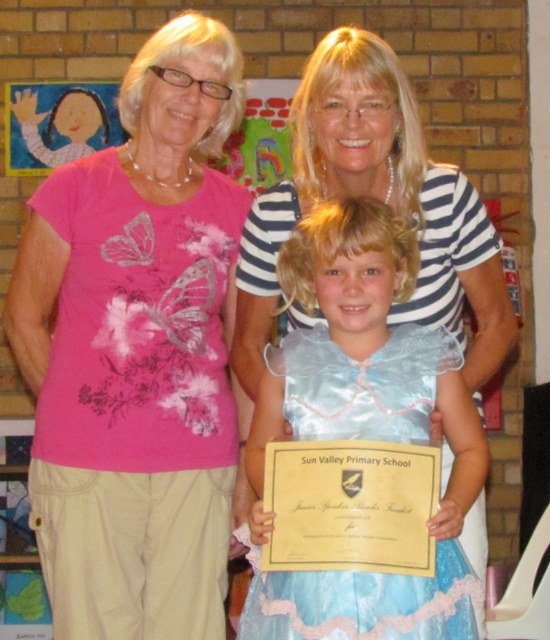
We had one Grade One from each of our classes up against the Grade 2s and 3s in the Speaker Reader finals on Wednesday.   There was much excitement as we filed into the hall.  There were four external judges seated at their tables ready and waiting. Who would the winner be? My little finalist was all dressed up in her tooth fairy outfit as she would be reciting a very topical poem about loose teeth!  Those judges had a hard job choosing a winner. All the children were dressed up fancily with elaborate props, their confidence was phenomenal and they presented their pieces with a polish that belied their age.   There was no microphone and the judges were right at the back of the hall. During practices I had encouraged h to her to speak as loudly as possible but she was still quite soft.  But when she got onto that stage she blew me away – WOW – her voice was animated, loud and clear!  She performed flawlessly. It just took an audience to bring out the best in her.  I could have burst with pride.

Calling on the Tooth Fairy

Calling on the Tooth Fairy

But the competition was strong and I thought at most she’d make it to third place.  Well the third place winner was announced and it wasn’t my fairy.  So when her name was called in second place I jumped up from my crouched position where I was taking photographs and cheered!    The third place was a Grade 3 girl who gave advice on how to survive as an eight-year-old and the winner was just outstanding – a wonderful poem about a smelly welly done by a talented little girl in Grade 3.

Proudly receiving her certificate

Proudly receiving her certificate

At my school there is always something happening.  We have a full programme of varied activities as we believe in teaching children not subjects.   However, the three RS are not to be neglected.  In order to do all the marvellous things we do we have to be creative about time management in order to fit everything in.  I find that honing in on small groups is the best way to ensure that each child’s needs are met.

Teaching children in small ability groups on the mat while the rest of the class get on with a task at their desks gives the teacher the opportunity to give each child the attention they need.  Each group will work at their level.  The material presented will never be too challenging for the slower learner nor too easy for the faster child.   Because of this, each child feels secure in her learning environment and  because she is not being stretched beyond her capabilities, she feels successful.

I know the answer!

I know the answer!

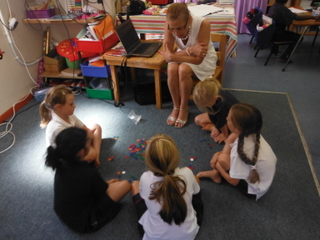
A six to seven year old child still needs to work in the concrete.  She learns to count by rote and to recognize number names and numerals even before she comes to school and this is important.  But learning the three-ness of 3 and whether four is more or less than five objects requires objects that can be seen and touched.   This is why it is important to be given this opportunity in the small learning group where the teacher can observe individuals and give guidance.

At home, counting actual objects, sorting socks into pairs, counting the cutlery when setting the table and sharing items with siblings and friends are all good concrete activities that help children master basic mathematical skills.

Grab 4 - change it to 6

Working with counters – first grab three – how many more to make 5.

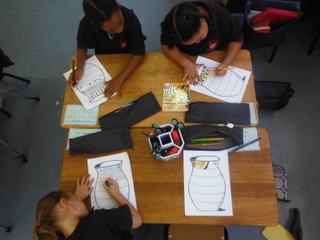
While one group is being taught on the mat the rest of the class get busy with a task.   We investigated shapes in nature and with this inspiration decorated an African Pot for a book cover.

Animal prints are so attractive

Animal prints are so attractive

Everyone had a different idea

Everyone had a different idea

Yesterday I asked my girls, Who wants to come back to school tomorrow?  They all put up their hands.  “Why do you want to come to school?”  The answers I got were all to do with play and fun.  – School is fun.  I can play.   I get to meet friends and make play dates.  Break is cool. –   And I was so waiting to hear – So I can learn to read, write and do mathematics!

Link
0

Another busy week at school has flown past.  Each class in the school has been preparing for the Speaker Reader Competition.  Every child had to prepare a story or a poem and orate before the class. The teacher then chose between three or five who performed for the whole grade.    How impressed we were at the standard of our brand new learners!    Choosing who to go through to the Foundation Phase finals was indeed difficult but after careful deliberation the four teachers were unanimous in their decision.   Quite by chance there was one winner from each of the Grade 1 classes.   More about the final outcome in a later blog!

The theme for this year at my school is “Irresistible Schooling”  We are teaching for the future and strive to make learning irresistible to our children.  On Thursday between 9 and 10 o’clock our classes were open to visitors who after listening to a brief talk by our principal wandered in and out at will to observe how we teach using digital devises.   In Grade 1 THRASS lessons were being presented on a digital white board in one class; a digital projector and screen in another; I had mine on a flat screen TV while another colleague had her children using I-pads.   Children today are born knowing how to work digitally so we do what we can to use a medium of instruction that they can relate to.

Perhaps in the future – the very near future – children will no longer require pens and pencils;  a frightening thought to many of the older generation.  But don’t panic – we are still teaching them penmanship.  Writing to an adult seems such a natural thing – you pick up a pen and all you think about is what you want to write.  You do not consciously consider which side of the page to begin on, where to begin each letter or even if it’s the left or the right hand page you need to write on.  But when you begin, all these things can be confusing.   So each lesson begins with mind moves to wake up the ears, the eyes and the brain.   Finger exercises prepare the fine muscles required to write neatly and we sing a song to remind us of correct posture.   To the tune of Frère Jacques/Brother John we sing – Lets write neatly, lets write neatly, sit up straight, sit up straight, put your feet together, put your feet together, heads up too, heads up too.  Imagine the concentration required to pay attention to sitting correctly, finding the right page, figuring out left to right direction and still having to form that letter the way the teacher is insisting upon.  It is exhausting both for the child and the teacher who has to be very aware of which children need extra attention in learning these skills.  Right from the beginning the child needs to learn the correct way of forming her letters so that those neural pathways are set and writing becomes an automatic skill.

Some things might interfere with a child learning to write.  Problems with spatial perception, fine motor coordination, motor planning etc.,  can be corrected with professional intervention.  If a teacher feels that a child is finding learning to write challenging, she may recommend an Occupational Therapy assessment.  Reading problems may also be present but not necessarily.  The thing to remember is that children do not deliberately write badly.   You might say – but he started off so well – but look at the mess at the end of the page. The thing is – that neat bit took an enormous amount of energy and concentration to get  right – and it simply could not be maintained.   Quite often children who are extremely neat while at the same time are very slow to complete tasks – need Occupational Therapy.  Their energies are going into getting it right – and not on the content of their work.   Today children with extreme writing problems are lucky –  digital devices take the stress out of having to write neatly.

Early diagnosis of problems is important but we allow children time to learn; we allow them to make mistakes and encourage them to practise the correct formations to set the neural pathways before we send parents for expensive assessments.