
0

Back in the Classroom – Writing, Creating and Prompting

The past week has been pretty hectic at school.  The intermediate phase are in the throes of producing a their pantomime – Snow White and the Seven Dwarfs.   Although my little Grade Ones are not involved, I am.  So for four days last week I had to leave them in the capable hands of a GAP student while I was on duty as Prompt.   But the shows began at 10 and I was back with the girls by 12:30.     So far we have had 2 full dress rehearsals, 2 morning shows and 2 evening shows.   There are two more evening shows to go so if you have not yet seen it don’t delay – it is really good.

The teaching of handwriting is very important in Grade 1.  So many skills are required to form a simple letter.   Posture must be right.  The fine muscles in the hand, fingers and wrist need to work correctly.  Spacial perception has to be developed and in the beginning it all takes a great deal of concentration which is why children with an attention deficit struggle to learn to write.

Now just when we have got used to how to form the letters and learned how to keep them on a line the goal posts have been moved.  The new skill we must learn is to write between the lines and we are practising this on paper before we get our feint lined books!
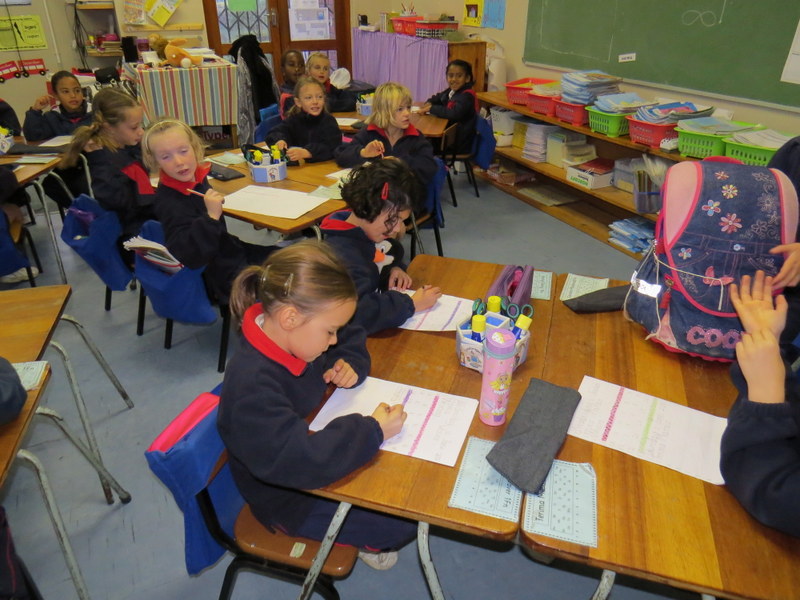
This takes concentration

This takes concentration

A good exercise to strengthen those three fingers required for neat writing – the thumb, pointer and middle is  paper tearing.  The girls got busy making a new book cover.  They had to tear coloured papers into small pieces and paste them onto an outline of a fish.

This is fun

This is fun

Its good for my 'three writing friends'

Its good for my ‘three writing friends’

I am working hard at this

I am working hard at this

Not so good for my back when I stand and bend over my desk when I work!

But the bending over a low desk is not so good for my back!Do you like the results?

Do you like the results?

The 16th of June is Youth Day in South Africa and as it fell on a Sunday (also Father’s Day) we got Monday off.   I hope all my little ones and their parents had a good weekend.  I certainly did – got a lot of Third Term preparation done as well as enjoying a relaxing time with my husband and daughter.

The last four days of term are now upon us.  Can you believe it – half way through the year already!

Link
0

Another busy week at school has flown past.  Each class in the school has been preparing for the Speaker Reader Competition.  Every child had to prepare a story or a poem and orate before the class. The teacher then chose between three or five who performed for the whole grade.    How impressed we were at the standard of our brand new learners!    Choosing who to go through to the Foundation Phase finals was indeed difficult but after careful deliberation the four teachers were unanimous in their decision.   Quite by chance there was one winner from each of the Grade 1 classes.   More about the final outcome in a later blog!

The theme for this year at my school is “Irresistible Schooling”  We are teaching for the future and strive to make learning irresistible to our children.  On Thursday between 9 and 10 o’clock our classes were open to visitors who after listening to a brief talk by our principal wandered in and out at will to observe how we teach using digital devises.   In Grade 1 THRASS lessons were being presented on a digital white board in one class; a digital projector and screen in another; I had mine on a flat screen TV while another colleague had her children using I-pads.   Children today are born knowing how to work digitally so we do what we can to use a medium of instruction that they can relate to.

Perhaps in the future – the very near future – children will no longer require pens and pencils;  a frightening thought to many of the older generation.  But don’t panic – we are still teaching them penmanship.  Writing to an adult seems such a natural thing – you pick up a pen and all you think about is what you want to write.  You do not consciously consider which side of the page to begin on, where to begin each letter or even if it’s the left or the right hand page you need to write on.  But when you begin, all these things can be confusing.   So each lesson begins with mind moves to wake up the ears, the eyes and the brain.   Finger exercises prepare the fine muscles required to write neatly and we sing a song to remind us of correct posture.   To the tune of Frère Jacques/Brother John we sing – Lets write neatly, lets write neatly, sit up straight, sit up straight, put your feet together, put your feet together, heads up too, heads up too.  Imagine the concentration required to pay attention to sitting correctly, finding the right page, figuring out left to right direction and still having to form that letter the way the teacher is insisting upon.  It is exhausting both for the child and the teacher who has to be very aware of which children need extra attention in learning these skills.  Right from the beginning the child needs to learn the correct way of forming her letters so that those neural pathways are set and writing becomes an automatic skill.

Some things might interfere with a child learning to write.  Problems with spatial perception, fine motor coordination, motor planning etc.,  can be corrected with professional intervention.  If a teacher feels that a child is finding learning to write challenging, she may recommend an Occupational Therapy assessment.  Reading problems may also be present but not necessarily.  The thing to remember is that children do not deliberately write badly.   You might say – but he started off so well – but look at the mess at the end of the page. The thing is – that neat bit took an enormous amount of energy and concentration to get  right – and it simply could not be maintained.   Quite often children who are extremely neat while at the same time are very slow to complete tasks – need Occupational Therapy.  Their energies are going into getting it right – and not on the content of their work.   Today children with extreme writing problems are lucky –  digital devices take the stress out of having to write neatly.

Early diagnosis of problems is important but we allow children time to learn; we allow them to make mistakes and encourage them to practise the correct formations to set the neural pathways before we send parents for expensive assessments.