24 August 2012
Those of you who follow and read my Blog regularly will know that at my school there is always something exciting happening. Each term we offer the learners a mini-break from regular school activities. The teachers (and a few kind friends of the school) have to come up with a fun club which the learners can apply for a small fee to participate in. The fee covers the costs involved plus a percentage which goes into school funds. We call these clubs, Funscapes. I cannot even begin to tell you how much effort, organisation and creativity goes into organising these events. In the first two terms we have ‘mini’ one day clubs which involves just the grade but in the third term two day Funscapes are offered and the children have to apply to join the one of their choice. Many wonderful things are on offer – cake decorating, fabric painting, ceramic painting, ice-skating, surfing, horse-riding, hiking, mini Olympics, Prince and Princess tea parties, amazing race and computer gaming, young scientist – the list goes on. How to compete with all these amazing clubs is something of a challenge. My passion as most of my readers know is Bird Watching. I have offered this as a Funscape before, but that was when I was a parent/grandparent. Then I took just 6 children in my own vehicle to visit a venue where water birds abound. Now that I am back in the classroom, I am expected to have at least 20 in my club. This means having to persuade parents to help with lifts – and on two days in a row this could be a challenge. Also if I don’t get the number of subscribers I desire I could be relegated to help with another over-subscribed Funscape. This is what happened to me last year when only 6 applied. But luck was on my side this year – I worded my advert differently, opened it to a wider age range and it worked. I had 21 young enthusiasts and 5 parents willingly offered to help with transport.
On Day 1 – I gathered my birders together in the classroom and gave them a super quick lesson on water birds and presented a slide show on what they were likely to see. After weeks of cold and wet weather, I prayed for a sunny, windless day as the wind can keen through those hides and I did not want my beginners to be put off for life. My prayers were answered when Thursday dawned crisp and clear and by the time we arrived at 11:00 a.m. the chill had turned to warm. We were the only school there and met up with just one other adult. My charges were extremely well-behaved and although I apologised to the gentleman for invading his peaceful morning he smile indulgently and said, “It’s great to see the young ones being introduced to birding – they’re no trouble at all.”
There were not too many birds but it was a good introduction and the kids were not confused by having to find the different species among a mixed flock.
Hippo frequent to waters of Rondevlei and the children were fascinated when I showed them evidence of where they emerged to graze at night. Maybe we will see one, they declared. No, I explained – they only come out at night and we won’t see them from the hides because they are further out in deep water during the day. (I have only once seen Hippo at Rondevlei)
We ended the excursion with a visit to the museum where they could study the stuffed models and get to see up close what the different birds and animals looked like in terms of colour and size.

First Hide at Rondevlei

Reed cormorant
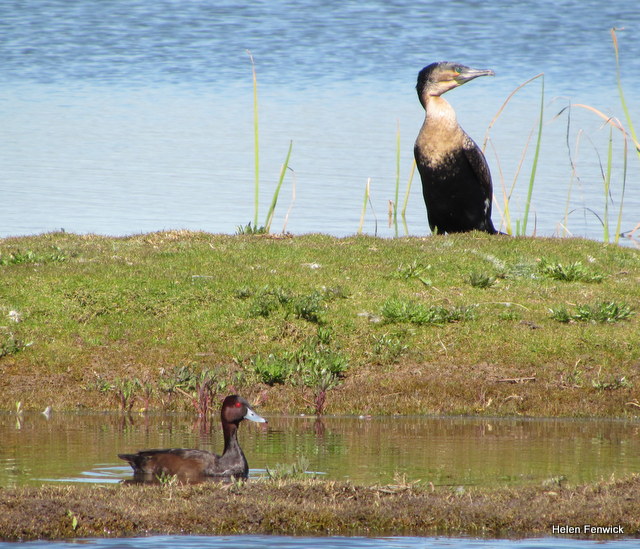
Southern Pochard and White-breasted Cormorant
Today, (Friday 24.8.12) we headed for Strandfontein Important Bird Area. Each child was given a Chart with the birds they were likely to see and a tick list. The settling ponds were alive with bird activity and there was lots to see. Each car had a walkie talkie and I kept up a constant commentary on what we were seeing, where to find the bird on their charts and now and then we stopped and got out of the vehicles to get a better view of the birds – but this was only when I was sure the movement of the children would not frighten our feathered friends away.
Recently in the news there has been reports of a hippo escaping from Rondevlei and wandering around the Zeekoevlei area. Residents of the suburb had been warned that this animal might wander around at night and could graze on their lawns. My young charges knew the story and knew too that we were going to a place right next door to Zeekoevlei. My colleagues at school were a tad nervous that we were going to escaped hippo territory and warned me to be careful – You might run into the hippo – please be careful. (The media really gets to people) I laughed and said, We should be so lucky!
The birding was great – we saw flamingos, red knobbed coots, yellow-billed ducks and Cape Teal. Hadedas, sacred and glossy ibis drew squeals of delight and this all before we very far into the sanctuary.
As we drove past one of the ponds – S7, I saw what looked like a block of wood floating in the distance. I ignored it as such until my walkie talkie crackled and an excited parent called – We see a Hippo. I thought I’d better check out my piece of wood with my binoculars and sure enough there it was – the stray from Rondevlei right under our noses! I hopped out the car and instructed the children to keep calm and gather at on the bank for a better look. Of course they were excited but they managed to contain themselves sufficient and did not yell and scream. The hippo cooperated beautifully and swam closer and closer to the bank. I guess he was just as curious about the children as they were about him. We spent a good half hour enjoying this unusual visitor to the old settling ponds of Strandfontein and then reluctantly moved on to enjoy some more feathered creatures.

Looking at the hippo

There he is

Hi Kids – Welcome to Strandfontein Important Bird Area
This was not the last exciting sighting of the day. Two porcupine made a brief appearance and quite a few of the children saw them well – my vehicle, unfortunately “dipped” on that one.
We stopped for a picnic lunch at the tern roost and watched the flamingos flying in and settling right in the pond right in front of us.
The children were thrilled to get a list of over 35 bird species and all declared that they had had an awesome outing. I hope this introduction to bird watching remains a hobby that they can do for the rest of their lives.
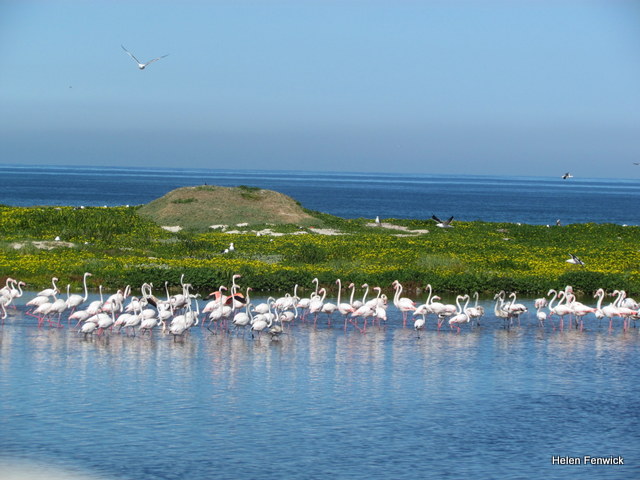
Flamingos
 Diary of an Adventurous Retiree
lovely Helen. lucky children.
LikeLike