0

Caravelle Cruising in Kruger October 2011 Day 4`

Wednesday 19 October 2011 Shingwedzi

There was a thunderstorm in the night and this morning it is still overcast with the threat of rain.

We leave camp at 6:00 an our first bird of the day is a marabou stork on top of a tree.

At 7:00 we take one of those little afrits that have a view over the river, is beautifully wooded and gives the opportunity to observe all kinds of beautiful birds.  Four ground hornbills strut along the bank .

Ground Hornbill

Then the party begins and the Cape Town physios, chiropractors and myosiopractitioners are going to be very busy when we return with stiff necks, sore backs, displaced hips and sciatica.   But it will be worth it – we watch the green woodhoepoes scurrying up and down the tree trunks and village weavers brighten up the scene with their brilliant yellow feathers. A cardinal woodpecker pecks busily looking for tasty wood-dwelling morsels and an orange-breasted bushrike appears in his splendor but refuses to sit still for a photo shoot.   Klaas’s Cuckoo calls out tantalizingly and finally Earlybird finds him and we get lovely views.   The light is not condusive to good photography but we don’t mind – just seeing the birds is enough for us.

Further along we are delighted to observe two yellow-billed hornbills apparently preparing a hole in a tree for occupation.  They both collect mud from a nearby puddle, fly to the hole and push the mud in.   Presumably, when the female is ready she will go into the hole and seal herself in, lose all her feather and rely on Dad to bring her nourishment till the chicks fledge.

Y.B. Hornbills preparing nest

At 9 o’clock we are watching yellow witogies, a paradise flycatcher, black-headed oriole, red-collared barbet,  and green woodhoepoes when a car pulls up beside us – Its another Sanparks Forum member and we exchange greetings and discuss sightings.

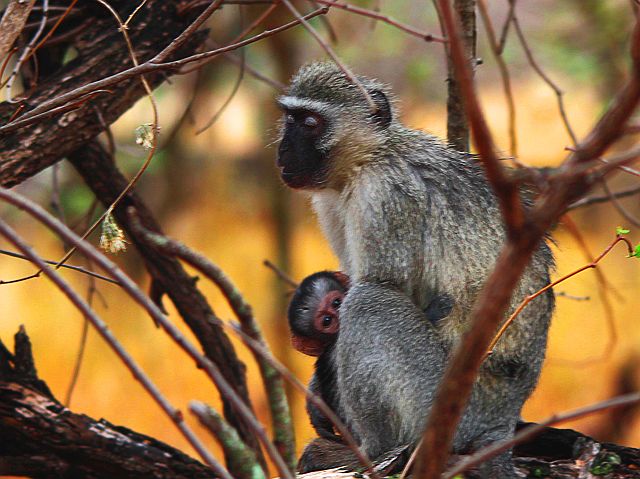
And then we bump into our cousin and her new baby.
The white-fronted bee-eaters are everywhere and so photogenic.

At 10:50 we arrive at Shanoa Look-out. EEC goes to the loo and returns to say they are in a horrible state.  That’s a pity because we’ve never found the long-drops a problem before – they’re always kept clean and serviced regularly.   Hopefully this is a one-off where for some reason things have become briefly out of control.

We get back to Shingwedzi at midday and decide on a few hours rest time.   We have a snack lunch and Earlybird has a nap while H2, EEC and I sit outside and observe the local wildlife.   We make a good list of birds.   Glossy starlings, brubrus, Go Away birds, Yellow-throated petronias (bathing in a puddle), southern black tit, yellow-billed, red-billed and grey hornbills.
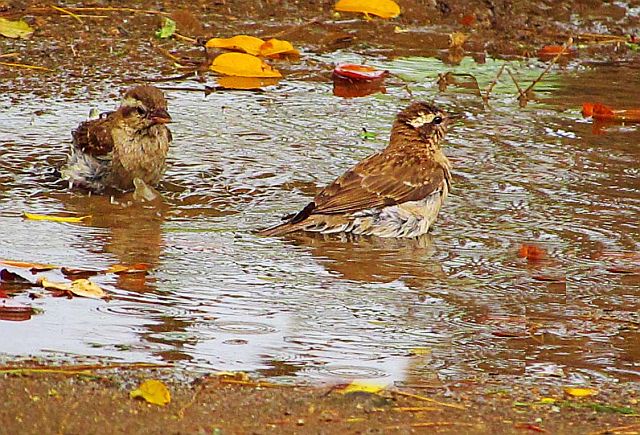
Yellow-throated petronia bathing

The Caravelle departs for the afternoon drive at half past three.  Once again we visit an  area near the river which is well-wooded and green and we find lovely birds.  At Kan Nie Dood Hide we see saddle-billed stork, Goliath Heron, greenshank and yellow-billed storks.  Hippos are wallowing and crocodiles look frightening as they lay on the river bank.

We continue our drive and stop to take wonderful photographs of two brown-headed kingfishers.  Imagine our delight when they kiss each other and then mate right in front of us.

Mating Kingfishers

Before arriving at camp we find a terrapin crossing the road.

Ray and Colette  come for drinks and we spend a very pleasant evening with them.   We chat about our two countries (they’re from New Jersey) and we are thrilled that they enjoy South Africa and our national parks enough to return year after year.   Lovely to meet you Ray and Colette!
0

Caravelle Cruising in Kruger October 2011 Day 3

Tuesday 18 October 2011 Letaba to Shingwedzi

We are all packed and ready to go by 6:00 this morning.   The first birds of the day are little swifts flying overhead then black headed oriole, brown-hooded kingfisher and  white-backed vultures

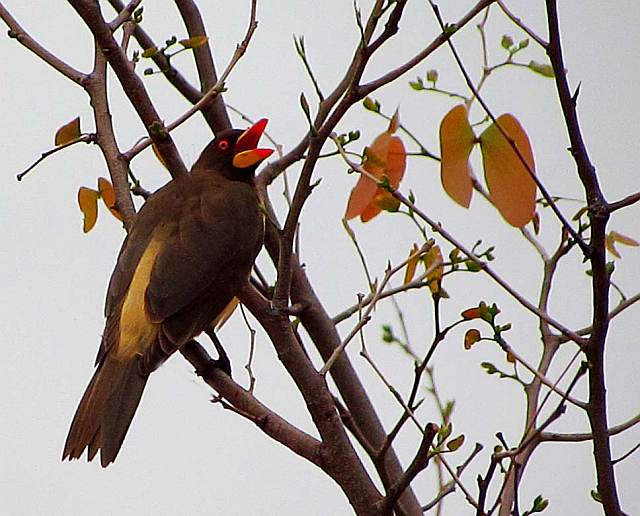
It is an overcast, cool day making driving the long distance to Shingwedzi quite pleasant.  Our plan is to stop at Mopani for breakfast between 9 and 10 depending on how much we see to delay us.   We make regular stops to observe the usual zebra, giraffe, elephant and buffalo.   l I remind my companions that we are in yellow-billed ox-pecker area and that their preferred client is the buffalo.   “I can see one with a red bill and yellow tip,” pipes up Eec.   Ha – that’s it!   And it is the only one among all the red-billed lot.  He flies up into a tree for a perfect portrait.

Yellow-billed ox-pecker

Further on we stop to observe an non-descript bird, and argue as to the likelihood of it being  is Sabota Lark.  Definitely a Sabota says H2 and Earlybird and I agree and prepare to move on.  “Hang on a minute,” says Eek in a  perfectly calm voice – “I can see a leopard in a tree!”

“You can’t,” come three disbelieving voices making a rapid 180   “What, where, are you sure!”   Yes of course she’s sure!   You can’t mistake a leopard in a tree!   It is about 250m from the road but oh so clear through our binoculars. She is languishing lazily on a branch and givese us a disdainful stare.   Eagle-Eye Carrol, you’ve earned your stripes,” I proclaim. – “You mean spots,” quips H2.   EEC is not amused.

Leopard in tree

All this adrenalin and it is only half past nine!    A more calming sighting of a small herd of tsesebe with some zebra and wildebeest settle us down before we arrive at Mopani for breakfast at 10 o’clock.

Tsebe and baby

What a lovely restaurant this is, and the health breakfast – muesli and fruit salad in tall glass – is highly recommended.

We take  our time and then browse in the shop which seems quite well stocked  and decide that on our return from Punda we will enjoy spending two nights here.

The next leg of the trip has us enjoying wonderful birdlife and we see a bateleur flying overhead, different francolins foraging busily on the side of the road, puff-backs flitting and calling their clicking call but refusing to pose for a portrait and red-headed weavers among other birds working busily in the trees.

Elephants, giraffe, zebra and buffalo are once again in evidence but no cats and no rhino.

A little steenbok stops us in our tracks when we observed him eating bark from a tree – is if for toothache or some other medicinal reason?

For a while there is not much to see so we chat while constantly checking the bush for the flick of a tail or the twitch of an ear.   Earlybird brakes and points up and there in an abandoned nest of some or other large bird is a Vereaux’s Eagle Owl.   And to our delight we could see the baby’s head peeping over the top of the twigs.  Perfect rented accommodation for the owls.

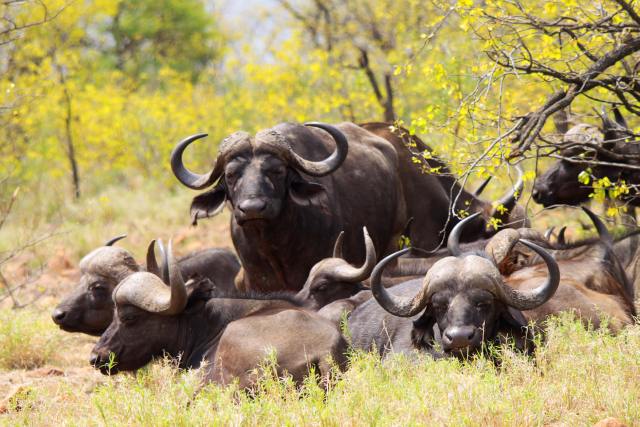
Just before arriving at Shingwedze we come across a big troop of ellies drinking in the river.  Then a large herd of buffalo starts coming down the bank to join them – what will  happen now – there isn’t  much room.  Well – the elephants politely make way for them and saunter off to their left and soon disappear leaving the buffs to enjoy a communal drink.   There is civility in nature.

At Shingwedzi check in is quick and smooth and we are assigned Cottage A29.   It is a little on the small side and a better option might have been two smaller huts with outside kitchens as the stoeps have low walls which make sitting outside somewhat cozier.  But we’re not complaining  – just being in Kruger is enough for us.

0

Caravelle Cruising in Kruger National Park October 2011 Day 2

Monday 17 October 2011

Today I declare Monday a day of rest.   Earlybird is whacked.   He insists on doing all the driving both from home to the park and in the park too.   He stresses when I drive so I just give in and allow him to be in control and then try and make everything else as easy as possible.   Of course he doesn’t like to be still and if he’s awake he just wants to get out there and find the critters!

So this morning we sleep in late.  My sister-in-law now to be known as Eec – (Eagle Eyed Carrol) and I wake first and have a cup of coffee. When H2 emerges we go for a walk along the path next to the river.  It is a cool and overcast day – not great for photography but we manage.

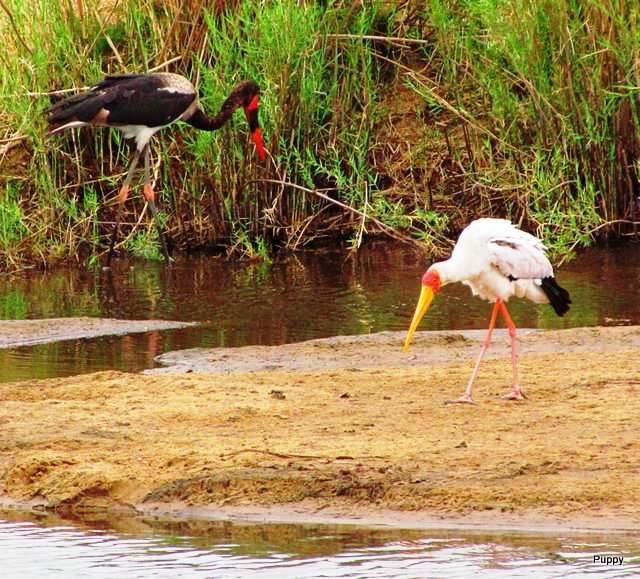
We didn’t get far because of all there is to see.  Saddle-billed storks, yellow-billed storks and a little egret are  busy in the shallow water among the reeds.

Immature Saddle-billed Stork and Yellow-billed Stork

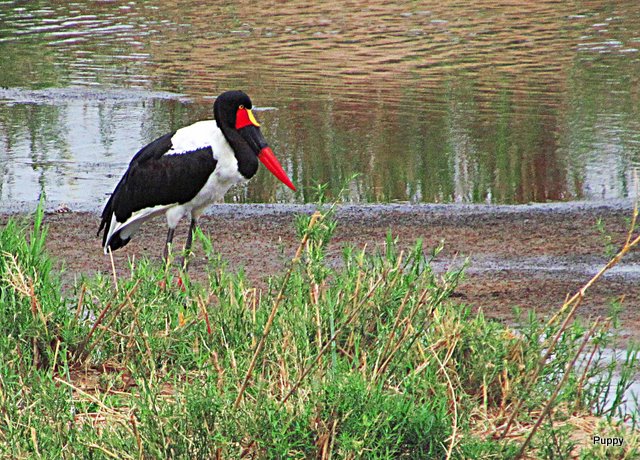
We spend ages watching them and other little birds that make  appearances from time to time.  Eventually my battery decides it has had enough and we return to the cottage for breakfast.  It is after 9 and Earlybird is relaxing on the stoop with his cereal and a cup of coffee.    At 10:00 we pile into the Caravelle and head along the H1-6 and take a loop.  First bird up is a yellow-billed kite then looking down on the river we spot a saddle-billed stork and a Great White Egret – two wonderful birds to start our drive.

Adult Saddle-billed Stork

The very first time I saw kudu females grazing silently in the early morning soft light I fell in love with them and that feeling has never faded.  So seeing them over and over again is always a thrill.  I just love their wise eyes and milk moustaches.

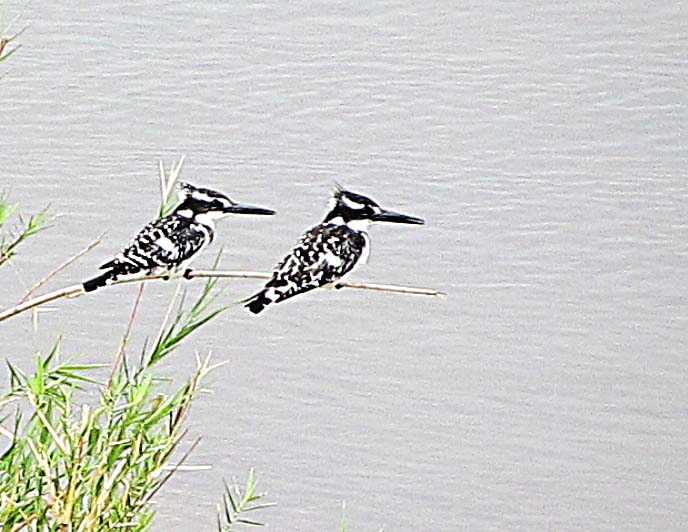
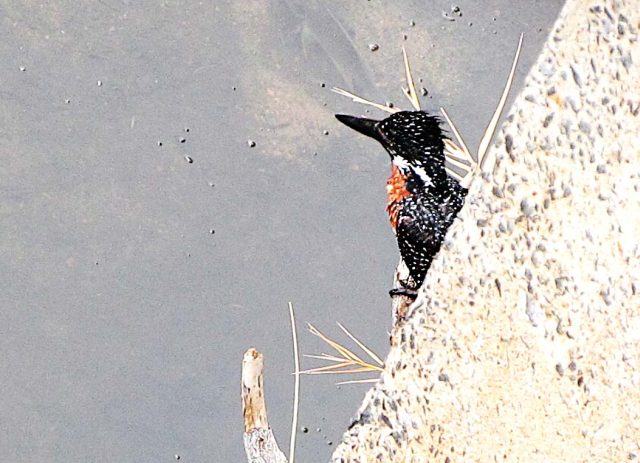
At first it looks like there is nothing to see when we stop on the bridge – Earlybird wants to drive on but we persuaded him to let us out for a leg-stretch and then we startto see things….. Eec draws our attention to a giant kingfisher whose head is poking out from under the bridge.  There are four pied kingfishers busily hovering and diving and catching tiny fish.

Kingfisher Couple

The Giant appears and is immediately mobbed and chased from their territory.

Giant Kingfisher under the bridge

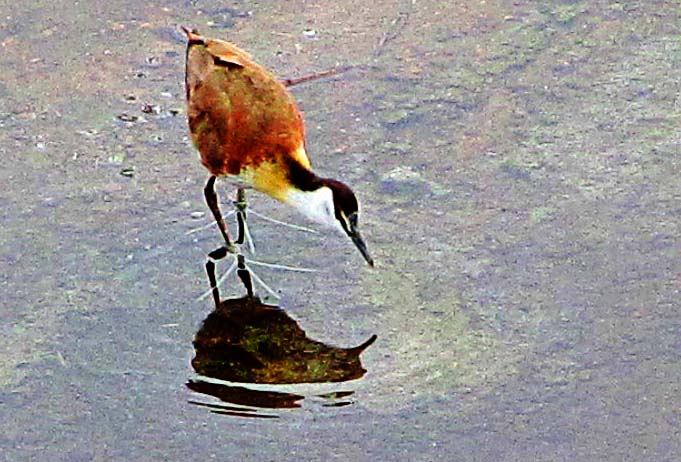
A single immature jacana is foraging on his own, a woodsandpiper struts about and a three banded plover looking as handsome as ever makes a brief appearance.

Juvenile Jacana

We move on and do the Engelhard loop.  There were stretches of nothing interspersed with the usual impala, zebra and kudu but none in huge numbers.  We were surprised in fact to find herd animals, singly, or in groups of less than five.  Perhaps when you live in close proximity to others of your species you need some alone time to reflect, look inward and find yourself?   But then again perhaps not – after all don’t they gather together for protection? No time for reflection when a lion is on your tail.

Birds as usual were our focus and we were not disappointed.   The route we took was green, wooded and near the river most of the wayWe found many bee-eaters, an osprey, jacana, squacco heron, white-browed scrub-robin, fish eagle, long-billed crombec and a sabota lark.

Kudu, elephant, buffalo, hippos and zebra also made frequent appearances.

At Matabeni Hide we find jacana, crocodiles and hippos and little else.

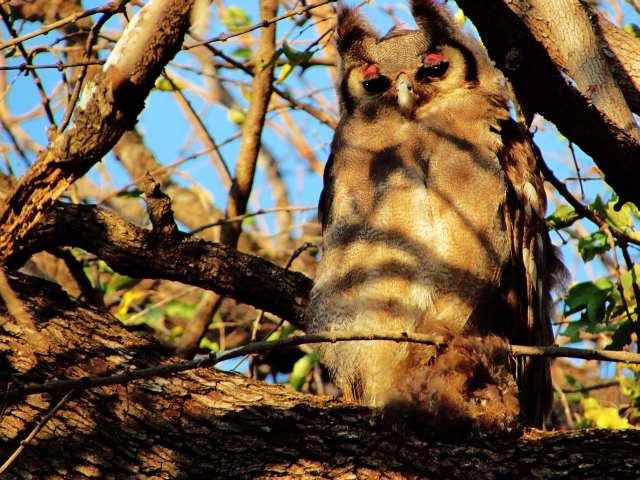
We return to camp for lunch and a rest then go out again at 4 o’clock.    It is a short and rewarding drive.   Chugging along slowly in a wooded area with lots of little “afrits” I keep my eyes up and scan the trees.    “Stop! Vereaux’s Eagle Owl,” I call.   This involves reversing and neck stretching and disbelief – where – I can’t see anything – you’re imagining things.   “There,” I insist – look behind that green leaf, in that crook of branch – no you’re looking in the wrong place – wait there’re two of them.”   Eventually I get everyone to find the place and Earlybird manoeveres the car into the perfect position so that we all got a perfect view of a Vereaux’s eagle holding prey in his talons.

Vereaux's Eagle-owl

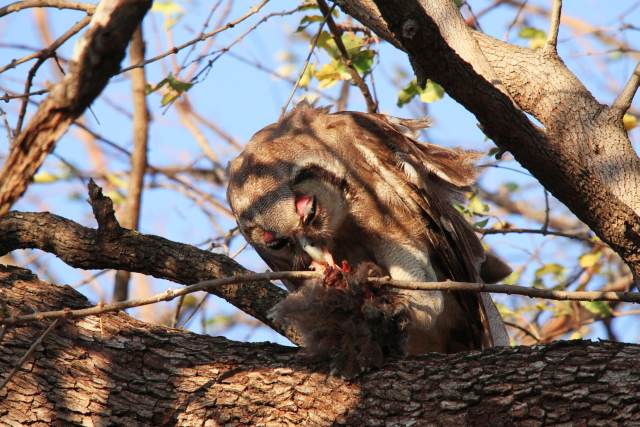
Oh wow – what a sighting – we guess it is a francolin – amazing as owls usually eat their prey whole but this chap is tearing it piece by piece and devouring it.

Feasting on a francolin

The photograph frenzy goes on for ages and we are the only car observing for quite a while – when others come we point out the two owls, folk look for a few seconds then take off, probably saying – strange people these bird nerds!  But boy do we have fun.   In order for H2 to get her fair share of good shots we swap places without getting out of the car – quite a feat for two ladies past their prime! I find that if I lie on the back bench of the caravel I can get quite a good view but while I am there I hear – knock knock knock and there next to my window is a Cardinal Woodpecker tapping into a tree.   Two good spots for the price of one!

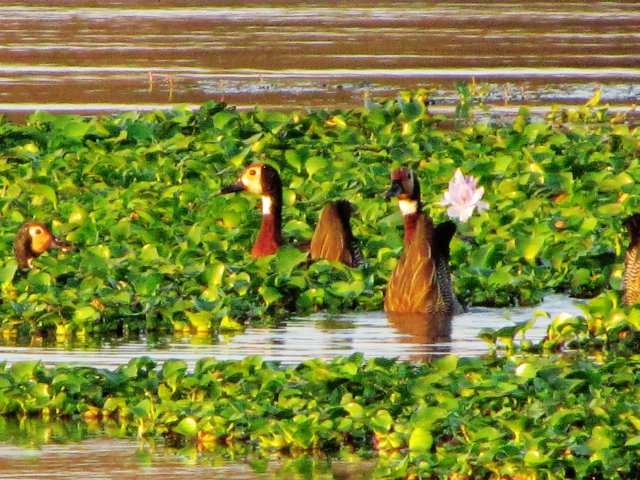
Moving on to a view of the river we find white-faced ducks and little bee-eaters.

White-faced ducks

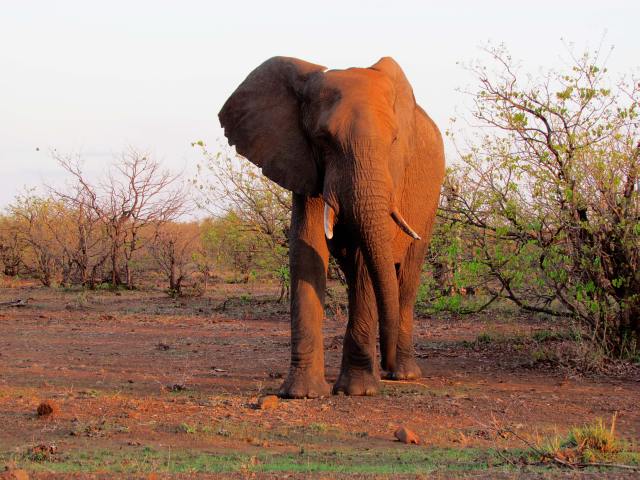
And just before getting back to camp we come across a lone elephant right next to the road.  We always treat ellies with respect but do not admit to Eec that we’re afraid of them.  She is quite sure they charge at the slightest provocation – or without!   Don’t go to close, Brother.   Careful he’s going to charge”   Don’t worry – he won’t we assure her then – an outlet of breath through the trunk, a stamp of the foot and a slight mock charge.  A collective intake of breath in the car then a burst of nervous laughter as Earlybird puts his foot down.